Compliance & Health
The core bloodborne pathogen cleanup requirements for businesses depend on occupational exposure. If an employee can reasonably be expected to contact human blood or other potentially infectious material while doing their job, OSHA 29 CFR 1910.1030 can require a written Exposure Control Plan, universal precautions, engineering and work-practice controls, PPE, initial and annual training, Hepatitis B vaccination offered within 10 working days of initial assignment, regulated-waste procedures, and no-cost post-exposure follow-up. Not every business automatically needs the full program; the trigger is the employee’s assigned exposure risk.
A small blood spot in an office restroom, a needle found in a parking lot, and a large blood spill after a serious accident are not operationally identical.
The right response depends on who is expected to clean it, how much contamination exists, whether sharps are present, and what waste will be generated.
That distinction matters because asking an untrained employee to “just wipe it up” can turn an ordinary incident into an occupational-exposure problem.
Does OSHA’s Bloodborne Pathogens Standard Apply to Every Business?
No. OSHA’s Bloodborne Pathogens Standard is based on occupational exposure, not simply on the possibility that blood could someday appear in a workplace.
The key question is whether an employee has reasonably anticipated skin, eye, mucous-membrane, or parenteral contact with human blood or other potentially infectious materials because of their assigned duties.
Job title alone does not answer that question.
A receptionist who unexpectedly encounters a customer’s nosebleed is different from a janitor whose assigned duties specifically include cleaning blood spills, handling contaminated waste, or servicing areas where needles may reasonably be found.
Practical rule: Decide who is expected to respond to blood before an incident happens. If employees are assigned that work and exposure is reasonably anticipated, build the required program around those employees rather than improvising after the spill.
This article deliberately focuses only on blood and other potentially infectious material.
For chemical labeling, Safety Data Sheets, wet floors, respirators, lockout/tagout, and the wider compliance picture, use the site’s 2026 OSHA requirements for commercial cleaning guide .
What Bloodborne Pathogen Requirements Must a Covered Business Have in Place?
When occupational exposure exists, compliance is more than buying gloves and disinfectant.
The employer must build a repeatable system.
| Requirement | What It Means for a Business |
|---|---|
| Exposure determination | Identify job classifications and tasks where occupational exposure occurs. OSHA requires this determination without assuming PPE will eliminate the exposure. |
| Written Exposure Control Plan | Document how exposure will be eliminated or minimized and how vaccination, training, cleanup, waste handling, and post-exposure procedures will work. |
| Universal precautions | Treat human blood and covered potentially infectious materials as though they are infectious. |
| Engineering and work-practice controls | Use safer procedures and equipment to reduce employee contact before relying only on PPE. |
| Personal protective equipment | Provide appropriate gloves, eye or face protection, garments, or other PPE based on the actual exposure. |
| Training | Provide required training at initial assignment and at least annually thereafter, at no cost and during working hours. |
| Hepatitis B vaccination | For covered employees, make vaccination available after required training and within 10 working days of initial assignment, subject to OSHA’s listed exceptions. |
| Housekeeping | Maintain a written cleaning and decontamination schedule appropriate to the facility, surfaces, contamination, and tasks. |
| Post-exposure procedure | Provide confidential medical evaluation and follow-up after a covered exposure incident, at no cost to the employee. |
| Recordkeeping | Maintain required training and medical records for OSHA’s specified retention periods. |
The Exposure Control Plan must be reviewed at least annually and when relevant tasks, procedures, technology, or employee positions change.
Does OSHA Require a Bloodborne Pathogens “Certification”?
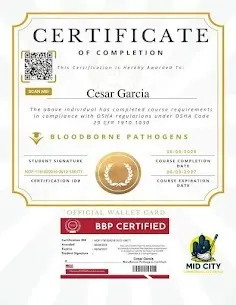
OSHA requires training for covered employees, but the Bloodborne Pathogens Standard does not create one universal OSHA-issued certification card that makes a person or company compliant.
A training certificate can document that training took place.
It does not replace the employer’s exposure determination, Exposure Control Plan, vaccination obligations, PPE selection, work practices, post-exposure program, or recordkeeping.
How Should a Business Clean a Blood Spill?
OSHA requires contaminated environmental and working surfaces to be cleaned and decontaminated after contact with blood or other potentially infectious material.
A surface that is overtly contaminated or affected by a spill must be decontaminated immediately or as soon as feasible.
The exact method should reflect the location, surface, amount and type of contamination, and work being performed in the area.
1. Control the Area
Keep unprotected employees, customers, patients, tenants, or visitors away from the contaminated area.
If broken glass, needles, or other sharps are present, the response procedure must address those hazards before ordinary wiping begins.
2. Use Appropriate PPE
Gloves are required when hand contact with blood, covered body fluids, contaminated surfaces, or contaminated items can reasonably be anticipated.
Eye, face, body, or other protection may also be required when splashing, spraying, soaking, or gross contamination is reasonably anticipated.
There is no honest “one PPE kit fits every spill” answer.
A few drops on an intact hard floor and a large pool of blood across porous flooring do not create the same exposure.
3. Remove Gross Contamination Safely
Visible soil may need to be removed before final disinfection because organic material can interfere with some disinfectants.
Cleanup materials themselves may become regulated waste depending on how contaminated they are.
4. Apply an Appropriate Disinfectant
The disinfectant must be appropriate for the organisms of concern and used according to its EPA-approved label.
EPA maintains List S for registered antimicrobial products with efficacy claims against common bloodborne pathogens such as HIV, Hepatitis B, and Hepatitis C.
Contact time matters.
Current EPA-listed products vary substantially. Depending on the product and pathogen, listed wet-contact times can range from 0.25 minute, or 15 seconds, to 10 minutes.
The product label—not habit or guesswork—controls the required use.
A common mistake: spraying a disinfectant and immediately wiping it dry. If the label requires the surface to remain visibly wet for a specified contact time, an immediate wipe can defeat the intended disinfection process.

Routine workplace disinfection is broader than bloodborne-pathogen response.
Businesses comparing those services can review how commercial sanitizing and disinfection services differ from ordinary cleaning.
What Counts as Regulated Bloodborne-Pathogen Waste?
Not every tissue, wipe, or trash bag that has a tiny blood mark automatically becomes regulated waste under OSHA.
OSHA’s definition includes categories such as:
- Liquid or semi-liquid blood or other potentially infectious material
- Items that would release blood or covered material if compressed
- Items caked with dried blood that could release material during handling
- Contaminated sharps
- Certain pathological or microbiological wastes containing blood or covered material
Regulated waste other than sharps must be placed in containers that are closable, constructed to contain the material and prevent leakage, properly labeled or color-coded, and closed before removal.
Important distinction: OSHA regulates employee exposure. Waste disposal is also affected by federal, state, and local environmental and waste rules. A red bag that satisfies an OSHA color-coding provision does not automatically prove that the waste can be transported or disposed of in a particular way.
What Happens if an Employee Is Exposed to Blood?
An exposure incident can include specific eye, mouth, other mucous-membrane, non-intact-skin, or parenteral contact with blood or other potentially infectious material resulting from the employee’s duties.
Following a reported covered exposure incident, the employer must make confidential medical evaluation and follow-up immediately available at no cost to the employee.
The process includes documenting the route and circumstances of exposure and addressing source-individual testing when applicable and legally permitted.
The healthcare professional may also evaluate post-exposure prophylaxis, counseling, testing, and follow-up based on current medical guidance.
The employer must obtain and provide the employee with the evaluating healthcare professional’s written opinion within 15 days after completion of the evaluation.
This is another reason not to invent the procedure after someone gets splashed or stuck.
The reporting pathway, medical contact, responsible manager, documentation process, and after-hours procedure should already be known.
How Long Must Bloodborne Pathogens Records Be Kept?
OSHA sets specific retention periods for covered records.
| Record | 2026 Requirement |
|---|---|
| Bloodborne-pathogens employee training records | Keep for 3 years from the date the training occurred. |
| Covered employee medical records | Keep for at least the duration of employment plus 30 years, subject to the applicable OSHA record rule. |
| Exposure Control Plan | Review and update at least annually and when relevant exposure conditions change. |
| Bloodborne-pathogens training frequency | Initial assignment and at least annually thereafter. Annual training must occur within one year of the prior training. |
Training records should document dates, training content or a summary, trainer names and qualifications, and the names and job titles of attendees.
What Are the OSHA Penalties in 2026?
Penalty amounts are useful context, but they should not be used as scare copy.
An actual OSHA citation and penalty depend on the facts, classification, employer size, history, good-faith adjustments, and enforcement process.
For violations occurring under the 2026 federal penalty schedule, the maximum for a serious violation is $16,550 per violation.
The maximum for a willful or repeated violation is $165,514 per violation.
Failure-to-abate penalties can reach $16,550 per day beyond the abatement date.
The better reason to build a proper program is simpler: an employee should not have to discover the company’s blood-exposure procedure after an exposure has already happened.
What Do Alabama Businesses Need to Know?
Alabama does not operate an OSHA-approved State Plan.
Federal OSHA therefore covers most private-sector employers and workers in the state.
Waste handling is a separate issue.
Alabama’s Department of Environmental Management maintains Division 17 requirements governing medical-waste management, including packaging, storage, transportation, treatment, and disposal requirements for waste that falls within those rules.
For example, Alabama’s current rules treat free-flowing material or items saturated to the point of dripping liquids containing visible blood or blood components as bulk blood or bulk blood components.
Untreated medical waste also has packaging and labeling requirements, and permitted transport can be required depending on the activity involved.
Do not make the disposal decision from an OSHA article alone. If a spill produces a meaningful quantity of blood-contaminated material, sharps, or other potentially regulated waste, verify the current ADEM requirements and the receiving facility’s rules before transportation or disposal.
Facilities with predictable exposure—medical offices, clinics, healthcare environments, and similar sites—also have cleaning requirements that extend well beyond an occasional office spill.
The site’s medical facility cleaning information covers that service-specific intent separately.

When Should a Business Use a Professional Cleanup Company Instead of Employees?
OSHA does not say that every drop of blood must be outsourced to a specialty contractor.
A business with properly trained, protected, and covered employees can have an in-house response process when its program is appropriate for the exposure.
Outsourcing becomes more sensible when:
- The business has not designated or trained employees for blood cleanup.
- The spill is extensive or has spread into porous materials.
- Needles, broken glass, or other sharps are involved.
- The scene involves trauma, an unattended death, or significant contamination.
- The business lacks appropriate PPE, disinfectants, containment supplies, or waste procedures.
- Cleanup would expose employees beyond the tasks contemplated by the existing Exposure Control Plan.
- Waste transportation or disposal requirements are unclear.
A small, controlled incident in a workplace with trained responders is not automatically the same thing as a trauma scene.
Conversely, calling ordinary janitorial staff after a serious incident simply because they are “the cleaners” is not a substitute for exposure planning.
If blood-response responsibilities are part of a recurring janitorial agreement, put those responsibilities in writing.
A documented commercial cleaning scope of work should distinguish ordinary cleaning from specialty, hazardous, or incident-response tasks.
How Much Does Bloodborne Pathogen Cleanup Cost?
There is no responsible flat price for blood cleanup without knowing the scene.
Cost can change based on:
- Amount and spread of blood or other material
- Hard versus porous surfaces
- Needles or other sharps
- PPE requirements
- Amount and classification of waste
- Transport or disposal requirements
- After-hours response
- Whether flooring, upholstery, drywall, or other materials must be removed
That is different from ordinary janitorial pricing.
The site’s 2026 commercial cleaning pricing guide lists standard office cleaning at roughly $0.08 to $0.18 per square foot per visit and specialized or one-time cleaning at roughly $40 to $60 per cleaner-hour.
Those figures should not be treated as a bloodborne-pathogen cleanup quote. Biohazard-related work may involve controls, waste, documentation, materials, and response conditions that routine commercial-cleaning rates do not capture.
A Practical Blood Spill Checklist for Business Owners and Facility Managers
- Determine who is authorized to respond. Do not automatically assign the closest employee.
- Restrict the contaminated area. Prevent unnecessary contact while the response is organized.
- Check for sharps. Needles and contaminated broken glass require specific handling.
- Use the PPE required for the anticipated exposure.
- Remove gross contamination using safe work practices.
- Use an appropriate disinfectant according to the product label and required contact time.
- Contain contaminated cleanup material correctly.
- Determine whether the material is regulated waste and which state/local disposal rules apply.
- Document and immediately report any employee exposure incident.
- Review the incident afterward. If the procedure failed, update the Exposure Control Plan, training, supplies, or assigned responsibilities.
What Should You Ask a Cleaning Contractor About Bloodborne Pathogens?
A facility manager does not need to become an OSHA inspector to ask useful questions.
- Are your employees expected to clean blood or other potentially infectious materials?
- How do you determine which employees have occupational exposure?
- Do covered employees receive initial and annual bloodborne-pathogens training?
- How do you handle Hepatitis B vaccination obligations for covered employees?
- What PPE is available for blood cleanup?
- Which disinfectants are used, and how do employees verify required contact times?
- What is your procedure if a cleaner finds a needle?
- How is regulated waste contained and disposed of?
- What happens if an employee has an exposure incident?
- Is blood or biohazard cleanup included in our contract, or is it excluded and separately quoted?
A contractor that answers these questions specifically is more useful than one that simply says, “Yes, we’re OSHA compliant.”
Frequently Asked Questions About Bloodborne Pathogen Cleanup
Does every business need a Bloodborne Pathogens Exposure Control Plan?
No. OSHA requires the plan when an employer has employees with occupational exposure to blood or other potentially infectious materials. The determination depends on reasonably anticipated exposure from assigned job duties.
Can regular janitors clean up blood?
Potentially, but if blood cleanup is an assigned duty creating reasonably anticipated occupational exposure, the employer must evaluate the job under OSHA’s Bloodborne Pathogens Standard and provide the required plan, training, controls, PPE, vaccination provisions, and other protections.
How often is bloodborne pathogens training required?
Covered employees must receive training when initially assigned to tasks with occupational exposure and at least annually thereafter. Additional training is required when changes to tasks or procedures create new occupational exposures.
When must Hepatitis B vaccination be offered?
For covered employees, OSHA generally requires the employer to make Hepatitis B vaccination available after required training and within 10 working days of initial assignment, unless an applicable exception applies.
Can an employee pick up a bloody piece of broken glass while wearing gloves?
No. OSHA states that contaminated broken glass should not be picked up directly with the hands. Mechanical means such as tongs, forceps, a brush, or a dustpan should be used.
Is a red bag always required for anything with blood on it?
No. OSHA’s regulated-waste definition depends on the material and its condition. State and local waste rules must also be considered. A small item with a minor blood spot is not automatically the same as liquid blood, dripping material, caked blood capable of release, or contaminated sharps.
Does spraying disinfectant make a blood spill safe?
Not by itself. The response also involves employee exposure controls, PPE, safe removal of contamination, correct product selection, label-required contact time, and appropriate handling of contaminated materials.
Does a bloodborne pathogens training certificate prove a cleaning company is OSHA compliant?
No. Training documentation is useful, but OSHA compliance also depends on the employer’s exposure determination, Exposure Control Plan, controls, PPE, vaccination provisions, housekeeping procedures, post-exposure response, and records.
Regulatory Sources Reviewed for This 2026 Guide
- Occupational Safety and Health Administration — 29 CFR 1910.1030, Bloodborne Pathogens
- OSHA — Bloodborne Pathogens and Needlestick Prevention Quick Reference
- OSHA — Housekeeping and Biological Hazards Guidance
- OSHA — Application of the Bloodborne Pathogens Standard to Contractors Cleaning Blood After Accidents
- OSHA — 2026 Annual Adjustments to Civil Penalties
- OSHA — State Plans, Alabama Federal OSHA Jurisdiction
- U.S. Environmental Protection Agency — Registered Antimicrobial Products Effective Against Bloodborne Pathogens, List S
- Alabama Department of Environmental Management — Division 17 Medical Waste Program
This guide summarizes generally applicable requirements. It does not determine whether a specific employee, spill, waste stream, or business is covered in a particular circumstance.