Compliance & Health
OSHA requirements for commercial cleaning depend on the hazards workers actually face; there is no single OSHA “commercial cleaning standard.” For many cleaning companies, the core rules include Hazard Communication for hazardous chemicals, accessible Safety Data Sheets (SDS), properly labeled containers, employee chemical-safety training, a documented PPE hazard assessment, appropriate gloves or eye protection when hazards require them, and controls for wet or hazardous walking surfaces. Additional standards can apply when cleaners may encounter blood or other potentially infectious materials, must wear respirators, or clean machinery where unexpected startup or stored energy could injure them. In Alabama, most private-sector cleaning employers are under federal OSHA jurisdiction.
The practical takeaway is that OSHA compliance is hazard-based.
A cleaner emptying office trash with a neutral cleaner does not necessarily have the same OSHA obligations as a cleaner handling corrosive chemicals, cleaning a healthcare area where blood exposure is reasonably anticipated, entering an industrial production zone, or servicing equipment that could unexpectedly energize.
This guide explains the federal OSHA standards most likely to matter to commercial cleaning employers and to facility managers vetting a cleaning contractor in Huntsville and across Alabama.

Is There One OSHA Standard for Commercial Cleaning?
No. OSHA itself describes cleaning-industry hazards as being addressed by specific OSHA standards for general industry. Commercial cleaning can involve chemicals, equipment, wet floors, biological exposure, lifting, electrical hazards, and work inside facilities with their own hazards.
That means a claim such as “we are OSHA compliant because our chemicals are OSHA approved” should immediately raise questions.
OSHA has specifically stated that it does not set “requirements” for cleaning chemicals in the sense of approving a particular cleaning product. Instead, standards such as the Hazard Communication Standard regulate how hazardous chemical information and protective measures are communicated to workers.
Better question: Instead of asking whether a cleaning product is “OSHA approved,” ask whether the employer has identified the product’s hazards, maintains the required SDS and labels, trains employees, follows the product instructions, and provides the controls and PPE required for the exposure.
Does Federal OSHA Apply to Commercial Cleaners in Alabama?
For most private-sector commercial cleaning employers, yes.
OSHA’s current State Plans page states that Alabama does not have an OSHA-approved State Plan and is under federal OSHA jurisdiction for most private-sector workers.
Federal OSHA does not cover Alabama state and local government workers under that arrangement. Different rules or employment structures can therefore matter if the work involves government employees rather than a private cleaning contractor.
For a private commercial cleaning company servicing offices, restaurants, medical offices, industrial facilities, and similar client sites in Huntsville, the relevant federal standards are generally found in 29 CFR Parts 1904 and 1910, depending on the work.
Compliance note: This article is educational, not legal advice. A specific requirement can turn on details such as employee status, the chemical used, the task performed, duration of exposure, client-site hazards, equipment, and whether another OSHA standard applies.
Which OSHA Requirements Can Apply to Commercial Cleaning?
The table below is a practical screening tool. It is not a complete list of every OSHA rule that could apply to every cleaning operation.
| OSHA area | Standard | When it matters to commercial cleaning |
|---|---|---|
| Hazard Communication | 29 CFR 1910.1200 | When employees may be exposed to hazardous chemicals during normal use or a foreseeable emergency |
| Personal Protective Equipment | 29 CFR 1910.132 | When workplace hazards are present or likely to be present that require PPE |
| Eye and Face Protection | 29 CFR 1910.133 | When splashes, liquid chemicals, acids/caustics, vapors, particles, or other eye/face hazards exist |
| Hand Protection | 29 CFR 1910.138 | When hands are exposed to harmful substances, chemical burns, cuts, punctures, or other covered hazards |
| Walking-Working Surfaces | 29 CFR 1910.22 | Wet floors, spills, obstacles, leaks, and other walking-surface hazards |
| Bloodborne Pathogens | 29 CFR 1910.1030 | Only where occupational exposure to blood or other potentially infectious materials is reasonably anticipated |
| Respiratory Protection | 29 CFR 1910.134 | When respirators are necessary to protect workers or required by the employer |
| Lockout/Tagout | 29 CFR 1910.147 | When cleaning is part of servicing/maintenance and unexpected startup or stored energy could injure a worker |
| Injury & Illness Reporting | 29 CFR Part 1904 | Recordkeeping where applicable, plus mandatory reporting of specified severe events |
1. Hazard Communication: Cleaning Chemicals, SDS, Labels, and Training
For many commercial cleaning companies, OSHA’s Hazard Communication Standard (HazCom), 29 CFR 1910.1200, is one of the most important compliance areas.
The standard applies to hazardous chemicals known to be present in the workplace in a way that employees may be exposed under normal conditions of use or in a foreseeable emergency.
When it applies, employers generally need a written hazard communication program addressing required elements such as:
- A list of hazardous chemicals known to be present
- Workplace labels and other required warnings
- Safety Data Sheets for hazardous chemicals
- Employee information and training
- Methods for informing workers about hazards from non-routine tasks
- Additional communication procedures for applicable multi-employer workplaces
Safety Data Sheets Must Be Accessible
OSHA requires employers to have an SDS in the workplace for each hazardous chemical they use and to ensure required SDS information is readily accessible to employees during each work shift.
Electronic SDS systems can be used, but OSHA states that they cannot create a barrier to immediate employee access.
For cleaners who travel between multiple client locations during a shift, the standard permits SDS to be kept at the primary workplace facility if employees can immediately obtain the required information in an emergency.
Secondary Bottles Still Need Attention
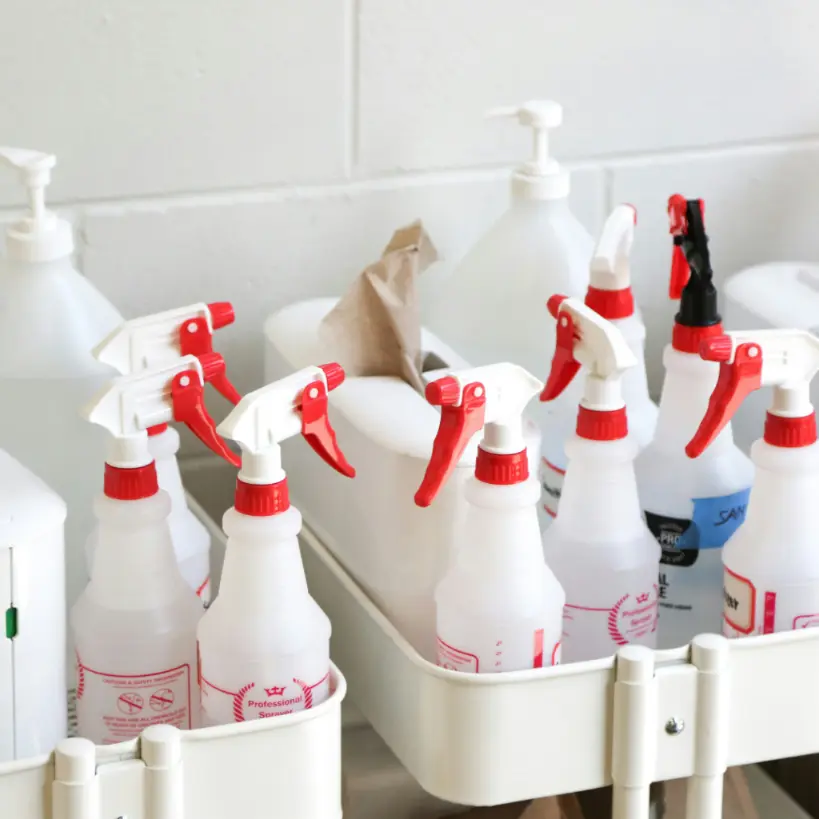
Commercial cleaning commonly involves diluting concentrates into spray bottles, mop systems, or other secondary containers. HazCom includes workplace-labeling requirements, so a company should not rely on workers remembering what an unlabeled bottle contains.
Buying a Cleaner at Retail Does Not Automatically Exempt It
HazCom contains a consumer-product exemption, but it depends on how the product is used. The exemption applies where workplace use results in a duration and frequency of exposure that is not greater than what consumers could reasonably experience when using the product for its intended purpose.
A product sold to consumers can therefore require a different compliance analysis when workers use it repeatedly throughout a commercial cleaning shift.
2. What Changed for Hazard Communication in 2026?
OSHA updated the Hazard Communication Standard in a final rule published in 2024 to align it primarily with Revision 7 of the Globally Harmonized System of Classification and Labelling of Chemicals.
The rule took effect July 19, 2024, but OSHA established phased compliance dates.
As of September 10, 2026, an important employer deadline has already passed:
| HazCom transition item | Deadline | Status on Sept. 10, 2026 |
|---|---|---|
| Manufacturers/importers/distributors — modified provisions for substances | January 19, 2026 | Passed |
| Employers — necessary workplace-label, HazCom-program, and additional-training updates for newly identified hazards involving substances | July 20, 2026 | Passed |
| Manufacturers/importers/distributors — modified provisions for mixtures | July 19, 2027 | Upcoming |
| Employers — necessary workplace-label, HazCom-program, and additional-training updates for newly identified hazards involving mixtures | January 19, 2028 | Upcoming |
The practical point for cleaning employers is not to assume an old SDS binder or training deck is permanently current. When updated hazard information creates new employee-protection or communication needs, the program may need to change.
3. What PPE Does OSHA Require for Commercial Cleaning?
OSHA does not require the same glove, goggle, or other PPE for every cleaning task.
Under 29 CFR 1910.132, employers must assess the workplace to determine whether hazards are present, or are likely to be present, that require PPE. When such hazards exist, the employer must select protective equipment that protects affected employees, communicate the selection decision, and ensure the PPE properly fits.
The employer must also verify that the required workplace hazard assessment was performed through a written certification.
Gloves
Under 29 CFR 1910.138, appropriate hand protection is required when employees’ hands are exposed to covered hazards such as harmful substances, chemical burns, cuts, punctures, severe abrasions, or harmful temperature extremes.
The correct glove depends on the task and chemical. “Disposable gloves” are not automatically suitable for every degreaser, disinfectant, stripper, acid cleaner, or solvent.
Eye and Face Protection
Under 29 CFR 1910.133, appropriate eye or face protection is required when employees are exposed to hazards such as liquid chemicals, acids or caustic liquids, chemical gases or vapors, or flying particles.
A splash-prone dilution task can therefore require different protection than routine dusting.
4. What Does OSHA Require for Wet Floors and Walking Surfaces?
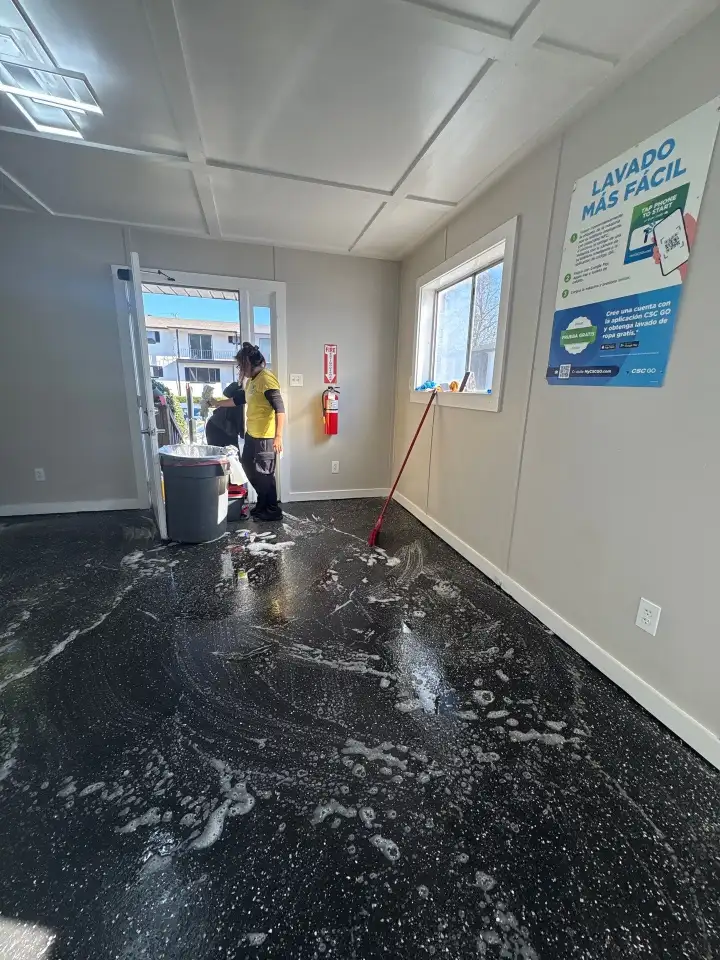
Commercial cleaners create temporary walking-surface hazards as part of normal work: wet mopping, auto-scrubbing, floor stripping, extraction, spill cleanup, cords, hoses, and equipment can all affect pedestrian routes.
Under 29 CFR 1910.22, employers must ensure that walking-working surfaces are kept clean, orderly, and sanitary. Workroom floors must be maintained in a clean and, to the extent feasible, dry condition, and walking-working surfaces must be kept free of hazards such as leaks and spills.
OSHA’s rule does not simply say “put out a yellow wet-floor sign and you are compliant.” A warning sign can be part of a control strategy, but the underlying obligation is to address the hazardous condition.
Depending on the situation, controls can include restricting access, sequencing work during low traffic, promptly recovering wet solution, routing cords safely, using barriers or warning devices, and leaving the walking surface in a safe condition.
For facilities where floor work is a substantial part of the scope, our commercial floor cleaning page covers the service side separately.
5. Do Bloodborne Pathogen Rules Apply to Commercial Cleaners?
Sometimes—but not to every cleaning employee automatically.
OSHA’s Bloodborne Pathogens Standard, 29 CFR 1910.1030, applies to occupational exposure to human blood or other potentially infectious materials (OPIM).
Housekeeping employees in healthcare and other settings can fall within the standard when their job duties create reasonably anticipated occupational exposure.
Where the standard applies, requirements can include:
- An exposure determination
- A written exposure control plan
- Engineering and work-practice controls
- Appropriate PPE
- Employee training
- Hepatitis B vaccination provisions
- Post-exposure evaluation and follow-up
- Specific housekeeping and decontamination procedures
The housekeeping section requires employers to maintain applicable worksites in a clean and sanitary condition and to determine and implement an appropriate written cleaning schedule and method of decontamination based on the location, surface, soil, and tasks or procedures performed in the area.
Surfaces that contact blood or OPIM must be cleaned and decontaminated as required by the standard.
Do not assume “commercial cleaning” equals “biohazard cleanup.” A standard janitorial contract should clearly define what happens if workers discover blood, sharps, or other potentially infectious material and whether the crew is trained, equipped, and assigned to handle that exposure.
For facilities with healthcare-specific cleaning needs, see our medical facility cleaning service page.
6. When Does OSHA Require a Respiratory Protection Program?
A dust mask or respirator should not be treated as a universal solution for strong cleaning fumes.
Under 29 CFR 1910.134, when a respirator is necessary to protect an employee’s health, the employer must provide an appropriate respirator and establish and maintain the required respiratory protection program.
When respirator use is required, the written program includes worksite-specific procedures and elements such as respirator selection, medical evaluations, fit testing where applicable, use procedures, maintenance, training, and program evaluation.
OSHA also has special provisions for voluntary respirator use. For voluntary use of filtering facepieces—often called dust masks—the written-program requirements are more limited, but the employer must still determine that voluntary use itself will not create a hazard and provide the information in Appendix D.
Important distinction: If a chemical creates an inhalation concern, the first question is not “Which mask should we buy?” It is what the SDS, exposure assessment, ventilation, substitution, and applicable OSHA standard require.
7. Can Lockout/Tagout Apply When a Cleaner Cleans Machinery?
Yes, in some industrial cleaning situations.
29 CFR 1910.147 covers servicing and maintenance of machines and equipment when unexpected energization, startup, or release of stored energy could injure employees.
The standard’s definition of servicing and maintenance specifically includes certain cleaning activities where the worker may be exposed to unexpected energization or startup or the release of hazardous energy.
This does not mean every exterior wipe-down of a machine requires lockout/tagout. It means a cleaning contractor should recognize the boundary between ordinary housekeeping and work that enters a hazardous servicing/maintenance condition.
For industrial sites, the client and cleaning contractor should define who is authorized to perform lockout/tagout, what areas or equipment are off-limits, and which cleaning tasks require the client’s energy-control procedure.
Our industrial cleaning service page similarly separates facility cleaning from specialized hazardous work and emphasizes site-specific safety boundaries.
8. What OSHA Rules Matter When Cleaners Work at a Client’s Facility?
Commercial cleaning is often a multi-employer arrangement: the cleaning company employs the cleaners, but the employees perform work inside another employer’s building.
Hazard Communication specifically addresses multi-employer workplaces.
When an employer produces, uses, or stores hazardous chemicals at a workplace in a way that employees of another employer may be exposed, its hazard communication program must address:
- How the other employer will get on-site access to relevant SDS
- How the other employer will be informed of precautionary measures needed during normal operations and foreseeable emergencies
- How the other employer will be informed of the workplace labeling system
This can run in both directions.
The cleaning contractor may bring floor chemicals or disinfectants into the building. The host facility may have laboratory chemicals, industrial processes, unlabeled pipes, restricted production areas, or other hazards that cleaners need to know about.
A strong onboarding process therefore includes more than keys and alarm codes. It should include the safety information necessary for the actual site.
9. What Are OSHA’s Injury Reporting and Recordkeeping Requirements?
OSHA recordkeeping and severe-injury reporting are related but different obligations.
OSHA states that many employers with more than 10 employees must keep records of recordable work-related injuries and illnesses using the OSHA 300, 300A, and 301 forms or equivalents, although size and industry exemptions can apply.
Separate from routine recordkeeping, all employers covered by the reporting rule must report specified severe events to OSHA:
- A work-related employee fatality: generally within 8 hours
- A work-related in-patient hospitalization: generally within 24 hours
- A work-related amputation: generally within 24 hours
- A work-related loss of an eye: generally within 24 hours
The rule contains definitions, timing conditions, and exceptions, so an employer should consult 29 CFR 1904.39 when an actual incident occurs.
What Should an OSHA-Oriented Commercial Cleaning Safety Program Include?
There is no one-page document that makes a cleaning company compliant with every OSHA standard. A practical program starts by identifying the hazards and then building the required procedures around them.
- Written Hazard Communication program where required
- Current hazardous-chemical inventory
- Accessible SDS for hazardous chemicals
- Compliant workplace labeling procedures
- Chemical-hazard employee training
- Procedures for non-routine chemical tasks
- Multi-employer HazCom procedures for client sites
- Documented PPE hazard assessment
- Task-appropriate hand, eye, face, or other PPE
- Wet-floor and walking-surface controls
- Equipment inspection and safe-use procedures
- Bloodborne-pathogen program where occupational exposure applies
- Respiratory protection program where respirators are required
- Lockout/tagout procedures where covered servicing work occurs
- Incident reporting and applicable injury-recordkeeping process
- Site-specific client hazard and access review
- Training records where required or useful for verification
- A process for updating procedures when chemicals or tasks change
The exact written programs and records required depend on which standards apply.
What OSHA Does Not Mean by “OSHA-Compliant Cleaning Products”
Marketing language around cleaning chemicals can be confusing.
OSHA does not maintain a general list of “OSHA-approved” janitorial chemicals. OSHA’s role is occupational safety and health. Chemical manufacturers classify hazards and provide required hazard information; employers use that information to protect workers.
Other regulators can govern other aspects of a product. For example, disinfectant claims are generally an EPA matter, not an OSHA product-approval program.
For worker protection, commercial cleaning employers should focus on the SDS, label directions, required dilution, exposure controls, PPE, ventilation, storage, and employee training rather than an unsupported “OSHA approved” marketing claim.
What Chemical Mistakes Create the Most Obvious Safety Concerns?
A compliance program should prevent basic mistakes before they become exposures.
Examples include:
- Putting hazardous cleaners into unlabeled spray bottles
- Using a product without making its required SDS accessible
- Giving employees a corrosive or irritant cleaner without hazard training
- Choosing gloves without checking chemical compatibility
- Pouring or diluting splash-hazard chemicals without appropriate eye/face protection
- Mixing incompatible products
- Using stronger-than-directed concentrations because “more is better”
- Spraying chemicals in poorly ventilated spaces without evaluating inhalation exposure
- Allowing client employees to be exposed to a contractor’s chemicals without required multi-employer communication
OSHA’s cleaning-industry resources specifically recognize hazardous chemicals, dangerous equipment, work tasks, and the physical work environment as hazards cleaning employers need to identify and control.
What Should a Facility Manager Ask a Commercial Cleaning Company About OSHA?
You do not have to audit every page of a contractor’s safety program to ask useful questions.
Before hiring a cleaner, ask:
- What hazardous cleaning chemicals will you bring into our facility?
- How can your cleaners immediately access the SDS while they are working here?
- How are secondary spray bottles and other workplace containers labeled?
- How are employees trained before using a new hazardous chemical?
- How do you determine which gloves, goggles, or other PPE a task requires?
- What is your process for controlling wet floors and equipment in occupied areas?
- What happens if a cleaner discovers blood, a needle, or another biological hazard?
- Do any tasks in our building require respiratory protection?
- Will your employees clean around machinery, and where is the boundary for lockout/tagout or prohibited work?
- What safety information do you need from us before your employees work on site?
Buyer takeaway: “OSHA compliant” is not a useful answer by itself. Ask the cleaning company to explain the process behind chemical communication, PPE, employee training, incident response, and site-specific hazards.
For the broader vendor-selection process, define the cleaning requirements in a written commercial cleaning scope of work and keep safety responsibilities clear alongside the service tasks.
If you are evaluating recurring service in Huntsville or North Alabama, see our commercial cleaning services and janitorial services. For higher-hazard environments, review our industrial cleaning and medical facility cleaning pages. When you are ready for a building-specific scope, request a walkthrough and quote.
Frequently Asked Questions About OSHA Requirements for Commercial Cleaning
What are the main OSHA requirements for commercial cleaning?
There is no single OSHA commercial-cleaning standard. Commonly applicable requirements include Hazard Communication for hazardous chemicals, Safety Data Sheets and labels, employee chemical-safety training, PPE hazard assessment and appropriate PPE, and safe walking-working surfaces. Bloodborne pathogens, respiratory protection, lockout/tagout, and other standards apply when the specific tasks and exposures trigger them.
Does OSHA require commercial cleaning companies to have Safety Data Sheets?
When the Hazard Communication Standard applies, employers must have a Safety Data Sheet in the workplace for each hazardous chemical they use and ensure the required information is readily accessible to employees during each work shift. For mobile workers traveling between workplaces, OSHA permits SDS to be kept at the primary workplace if employees can immediately obtain the information in an emergency.
Does OSHA require cleaners to wear gloves?
OSHA does not impose one glove rule for every cleaning task. Under 29 CFR 1910.138, employers must select and require appropriate hand protection when employees’ hands are exposed to covered hazards such as harmful substances, chemical burns, cuts, punctures, severe abrasions, or harmful temperature extremes. The glove must be selected for the actual task and hazard.
Does OSHA require wet-floor signs when mopping?
OSHA’s walking-working-surface standard requires workplaces and walking surfaces to be kept clean, orderly, sanitary, and, to the extent feasible, dry, and free of hazards such as spills and leaks. The standard does not make a yellow wet-floor sign the only required control. Signs or barriers can be part of the method used to protect people while the wet condition is being controlled.
Do bloodborne pathogen rules apply to all janitors and cleaners?
No. OSHA’s Bloodborne Pathogens Standard applies when there is occupational exposure to human blood or other potentially infectious materials. If a cleaner’s assigned duties create reasonably anticipated exposure, the employer must evaluate and comply with the applicable requirements, which can include an exposure control plan, training, protective measures, vaccination provisions, and decontamination procedures.
Does OSHA require an N95 or respirator for cleaning chemicals?
Not automatically. If respiratory protection is necessary to protect an employee’s health or is required by the employer, 29 CFR 1910.134 can require an appropriate respirator and a respiratory protection program. Employers should evaluate the chemical, SDS, exposure, ventilation, and available controls rather than treating an N95 or dust mask as a universal solution.
Are cleaning chemicals OSHA approved?
OSHA does not operate a general approval program for janitorial cleaning chemicals. OSHA regulates workplace hazards and worker protection through standards such as Hazard Communication and PPE requirements. Product-specific claims such as disinfectant registration may fall under other agencies, including EPA, depending on the product and claim.
Does Alabama have its own OSHA program for private commercial cleaners?
No. Alabama does not operate an OSHA-approved State Plan. Federal OSHA covers most private-sector employers and workers in Alabama. Federal OSHA does not cover Alabama state and local government workers under that arrangement.
Published: September 10, 2026 · Federal OSHA sources reviewed: September 10, 2026