Commercial Floor Care
Commercial epoxy floors should generally be kept free of abrasive dust and debris, cleaned promptly after spills, and routinely mopped or machine-scrubbed using a cleaner and equipment compatible with the specific resinous floor system.
For routine foot-traffic areas, a neutral floor cleaner is often appropriate. Industrial areas with grease or heavier soil may require a compatible degreaser and mechanical agitation. Textured or slip-resistant epoxy usually requires more brushing or scrubbing than a smooth epoxy surface.
Epoxy flooring has a reputation for being low maintenance, but low maintenance does not mean no maintenance.
Fine dirt can behave like abrasive grit under shoes, carts and forklift tires. Oil can create a slip hazard. Repeated rubber marks can become difficult to remove. Using the wrong pad or cleaning chemical can also change the appearance of some resinous floor systems.
A good epoxy-floor maintenance program therefore combines frequent soil removal with the least aggressive cleaning process that gets the floor clean.

How Do You Clean a Commercial Epoxy Floor?
The exact procedure should follow the manufacturer or installer’s instructions for the actual flooring system.
That matters because “epoxy floor” can describe many different resinous systems, including smooth coatings, broadcast floors, heavily textured systems and multi-layer assemblies with different topcoats.
A practical general process is:
- Remove loose soil first. Sweep, dust mop or mechanically sweep the floor before wet cleaning.
- Select the appropriate cleaner. Match the cleaning chemical to both the floor system and the type of soil.
- Apply the cleaning solution correctly. Follow the cleaner’s dilution and application instructions.
- Agitate the soil. Use a suitable mop, brush or floor-scrubbing machine depending on the floor’s texture and size.
- Allow appropriate dwell time when the product requires it. Heavy soil often needs time for the cleaning chemistry to work.
- Remove the dirty solution. Use a wet vacuum, automatic scrubber, mop or other appropriate recovery method rather than allowing contaminated solution to dry back onto the floor.
Cleaning chemistry is only half the process. Agitation and soil recovery matter. Putting detergent onto an epoxy floor and moving dirty water around with a mop is not the same as removing the contamination.
Epoxy Floor Cleaning and Maintenance Schedule
There is no universal cleaning interval for every epoxy floor.
A lightly used office floor, automotive service area, warehouse aisle, commercial kitchen and manufacturing floor can all require different frequencies.
| Frequency | Typical Tasks | When to Increase Frequency |
|---|---|---|
| Daily / As Needed | Sweep or dust-remove abrasive debris, address spills and remove localized contamination. | Heavy foot traffic, manufacturing debris, forklifts, outdoor soil, oil or food-service use. |
| Routine | Damp mop or machine scrub using a compatible cleaner. | When traffic lanes become visibly dirty or film begins building up. |
| Periodic Deep Cleaning | More intensive agitation, edge cleaning, degreasing and detailed treatment of textured areas. | Grease, rubber marks, embedded soil or areas ordinary cleaning cannot restore. |
| Condition-Based | Inspection for scratches, worn topcoat, loss of texture, coating damage or areas becoming unusually difficult to clean. | High mechanical wear, forklifts, impact, chemicals or sustained heavy traffic. |
The best schedule is therefore based on traffic and soil load rather than the calendar alone.
What Cleaner Should You Use on Epoxy Floors?
Use a cleaner that is compatible with the installed coating system and appropriate for the type of soil being removed.
For general foot-traffic areas, a compatible neutral floor cleaner is often a sensible starting point.
Areas with oils, grease or heavier industrial soil may require a manufacturer-compatible cleaner/degreaser.
| Soil / Facility Type | Typical Cleaning Approach |
|---|---|
| General foot traffic | Compatible neutral floor cleaner |
| Light commercial soil | General-purpose compatible cleaner |
| Oil or grease | Compatible cleaner/degreaser |
| Heavy industrial contamination | Heavier-duty compatible degreasing process |
| Specialty ESD or conductive floor | Use products approved for that specialized floor system |
Do not choose a cleaner simply because it is strong. Some cleaning chemicals can affect the color, gloss or texture of polymer flooring. Follow the coating manufacturer’s recommendations and test an unfamiliar cleaner in a small inconspicuous area before expanding its use.
Can Epoxy Floors Be Machine Scrubbed?
Yes, many commercial and industrial epoxy floors can be cleaned with an automatic scrubber or rotary floor machine.
The correct brush or pad depends on the floor system.
The goal is to provide enough agitation to remove soil without unnecessarily abrading or scratching the coating.
A machine-scrubbing program should account for:
- Whether the surface is smooth or textured
- The manufacturer’s recommended brush or pad
- Machine weight and brush pressure
- Cleaning chemical compatibility
- Traffic soil and grease load
- Water and solution recovery
- Edges and corners the machine cannot reach
More aggressive is not automatically better. Excessively aggressive pads, brushes or pressure can create avoidable wear even on a durable industrial floor.
For building-wide machine floor care, Mid City also provides commercial floor cleaning in Huntsville .
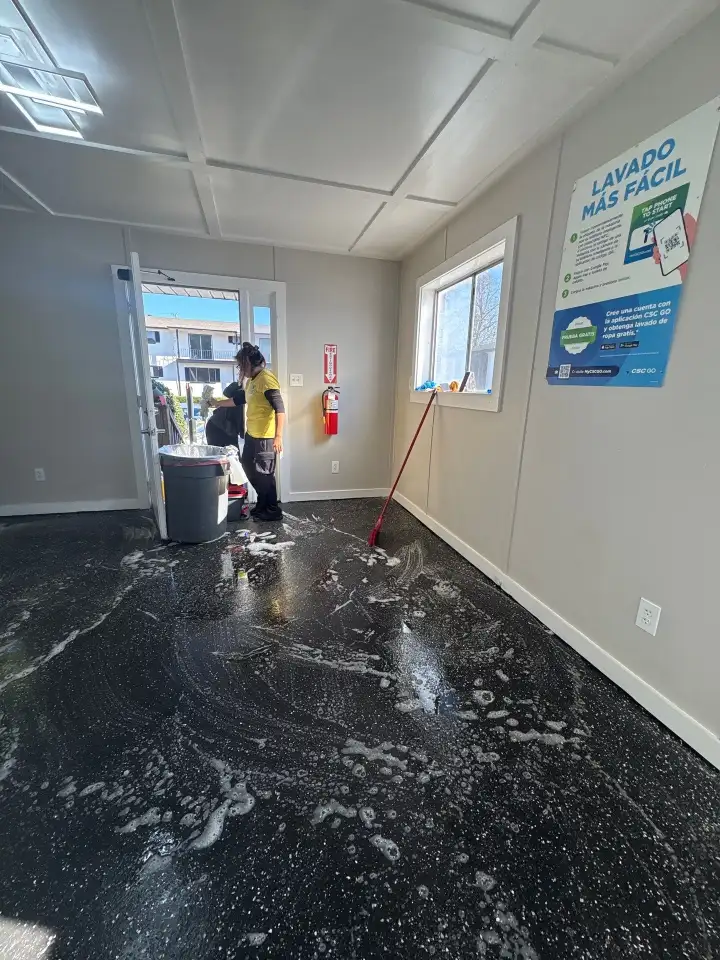
How Do You Clean Textured or Slip-Resistant Epoxy Flooring?
Textured epoxy generally requires more agitation than a smooth coating.
The same texture that can improve traction also creates low points where dirt, grease and cleaning residue can accumulate.
A standard mop may pass across the top of the texture without adequately cleaning those recessed areas.
Depending on the flooring system, maintenance may require:
- A deck brush
- A suitable bristle brush
- A rotary machine with an appropriate brush
- An automatic scrubber
- Wet recovery or vacuuming of dirty solution
This is particularly important in commercial kitchens, ramps, locker rooms, industrial production areas and other places where aggressive texture has been added for slip resistance.
How Do You Remove Grease, Oil and Rubber Marks From Epoxy?
Start by identifying the contamination rather than automatically using the strongest available chemical.
For oil and grease, use a compatible degreasing product at the correct dilution and allow the required dwell time before agitation.
Scrubbing helps break the bond between the contamination and the floor. The dirty solution then needs to be recovered.
Repeated rubber tire or forklift marks may also need additional agitation and an appropriate cleaner.
A greasy industrial floor should not simply be wet-mopped. A mop can redistribute oily contamination instead of removing it. Use a cleaning process capable of emulsifying, agitating and recovering the grease.
How Quickly Should Spills Be Removed From Epoxy Flooring?
As soon as practical.
Prompt spill removal serves two purposes.
First, liquid contamination can create a slip hazard.
Second, leaving chemicals, oils, dyes or other contaminants on the surface unnecessarily increases the chance of staining or coating damage.
Epoxy systems can have excellent chemical resistance, but chemical resistance is system-specific.
A coating designed for an office, warehouse or decorative environment should not automatically be assumed to tolerate every industrial chemical.
If an unusual chemical is spilled, consult the floor-system documentation or installer rather than guessing.
How Do You Prevent Scratches and Premature Dulling?
Epoxy is hard and durable, but hard coatings can still be scratched.
One of the simplest ways to protect the finish is to keep abrasive grit off the floor.
- Remove dust, sand and grit frequently.
- Use effective entrance matting where outside soil enters the building.
- Clean wheels and casters that carry abrasive debris.
- Avoid dragging pallets, metal legs or heavy equipment across the floor.
- Protect the surface when moving heavy machinery.
- Reduce forklift spinning and skidding where operationally possible.
- Use compatible brushes and pads during mechanical cleaning.
- Clean spills before they become sticky soil traps.
Think of loose grit as sandpaper. Traffic repeatedly grinds those particles against the coating, gradually affecting gloss and appearance.
Should Epoxy Floors Be Waxed?
Traditional stripping and waxing is not normally the default maintenance procedure for an epoxy floor.
Epoxy is a resinous coating system, while traditional strip-and-wax programs are strongly associated with floors such as VCT that use a replaceable floor-finish system.
Sherwin-Williams, for example, describes poured epoxy floors as typically requiring minimal upkeep and no waxing as part of ordinary maintenance.
Some specialty resinous systems or facility programs may use additional coatings or finishes, so the installed flooring system should still be identified before changing the maintenance process.
Do not apply VCT maintenance logic to epoxy automatically. If you do not know what floor system is installed, identify it before using stripper, polish, wax or another sacrificial finish.
For floors actually designed around stripping and refinishing, see our separate guide to commercial floor stripping and waxing .
Why Does an Epoxy Floor Start Looking Dull?
Dull appearance does not automatically mean the epoxy coating has failed.
Possible causes include:
- Fine abrasive scratching from dirt and sand
- Cleaner residue
- Grease or oily film
- Hard-water or mineral residue
- Incorrect cleaning chemistry
- Rubber marks
- Heavy mechanical traffic
- Wear of the topcoat
The first step is therefore to determine whether the problem is soil sitting on the coating or wear occurring within the coating.
Deep cleaning can solve the first problem. It cannot reverse physical coating loss.
When Does an Epoxy Floor Need Recoating Instead of Cleaning?
Cleaning removes contamination. It does not rebuild a worn coating.
A floor should be evaluated for repair or recoating when you begin seeing conditions such as:
- Persistent loss of appearance that cleaning does not restore
- Heavy scratching or abrasion
- Areas where the coating has worn through
- Peeling, delamination or blistering
- Impact damage
- Deep gouges
- Cracks associated with substrate movement
- Loss of required surface texture
- Areas that have become progressively difficult to clean
The correct repair depends on the existing coating system and the condition of the concrete beneath it.
Floor-cleaning crews can identify and report deterioration, but coating repair or recoating should follow the system manufacturer’s or qualified flooring contractor’s specifications.

Maintaining Epoxy Floors in Warehouses and Industrial Facilities
Industrial epoxy flooring usually needs a zone-based maintenance plan.
A warehouse does not soil evenly.
Main forklift aisles, loading areas, production cells and entrances often deteriorate much faster than low-use storage areas.
| Zone | Typical Maintenance Priority |
|---|---|
| Main aisles | Frequent sweeping and condition-based machine scrubbing |
| Loading / staging areas | Debris removal, tire-mark control and heavier soil management |
| Production areas | Soil- and process-specific cleaning coordinated with site rules |
| Low-use storage zones | Lower-frequency routine maintenance based on actual condition |
| Entrances | Frequent removal of tracked-in abrasive grit |
Mid City’s industrial cleaning services in Huntsville include floor-care planning for compatible sealed concrete and epoxy surfaces alongside broader facility housekeeping.
Common Epoxy Floor Cleaning Mistakes
1. Letting Abrasive Dirt Stay on the Floor
Dirt, sand and grit can scratch the finish under repeated foot or wheel traffic.
2. Using the Same Cleaner on Every Epoxy System
Resinous floors vary. The cleaner should be compatible with the actual coating system.
3. Using a Mop for Heavy Grease
Mopping can redistribute oily contamination instead of extracting it. Heavy grease normally requires appropriate degreasing, agitation and recovery.
4. Using an Overly Aggressive Scrubbing Pad
More abrasion can create avoidable wear. Match the brush or pad to the manufacturer’s instructions.
5. Ignoring Textured Areas
Dirt can become trapped in a skid-resistant profile. Textured floors commonly need brush-based agitation.
6. Leaving Dirty Cleaning Solution Behind
Soil suspended in cleaning solution should be recovered rather than allowed to settle or dry back onto the coating.
7. Treating Coating Damage as a Cleaning Problem
Scratches, worn topcoats, delamination and physical coating loss cannot be restored simply by cleaning harder.
Commercial Epoxy Floor Maintenance Checklist
- Identify the installed resinous floor system before selecting chemicals.
- Remove abrasive grit and debris frequently.
- Clean spills promptly.
- Use a compatible routine cleaner.
- Use appropriate degreasing chemistry for grease and oil.
- Match brushes and pads to the flooring system.
- Use brush agitation on textured floors when required.
- Recover dirty cleaning solution after scrubbing.
- Protect floors when moving heavy equipment.
- Monitor forklift and cart traffic for excessive scratching or skidding.
- Inspect traffic lanes for coating wear.
- Report cracks, gouges, peeling or delamination.
- Review cleaning chemistry if gloss, color or texture changes.
- Schedule deeper cleaning based on actual soil rather than an arbitrary date.
- Consult the coating manufacturer or installer when recoating becomes necessary.
Frequently Asked Questions About Epoxy Floor Cleaning and Maintenance
What is the best way to clean an epoxy floor?
Remove loose and abrasive debris first, apply a cleaner compatible with the installed resinous-floor system, agitate as needed with an appropriate mop, brush or floor machine, and remove the dirty solution. Smooth and textured systems may require different tools.
What cleaner should I use on an epoxy floor?
The coating manufacturer’s guidance should control. A compatible neutral floor cleaner is often suitable for ordinary foot-traffic soil, while grease and heavier industrial contamination may require an appropriate cleaner/degreaser.
Can you use an automatic scrubber on epoxy flooring?
Many commercial epoxy floors can be machine scrubbed. The correct brush, pad, pressure and chemical depend on the installed coating system and surface texture. Follow manufacturer or installer guidance rather than assuming one machine setup is appropriate for every floor.
How often should an epoxy floor be cleaned?
Frequency should follow traffic and soil conditions. Abrasive debris and spills should be removed promptly, while mopping or machine scrubbing can be scheduled according to how quickly the floor becomes dirty. Busy industrial and food-service floors normally require more frequent attention than lightly used commercial areas.
Should epoxy floors be waxed?
Traditional strip-and-wax maintenance is not normally required for a standard epoxy coating. Resinous floors usually rely on cleaning and maintenance of the installed coating itself. Specialty systems can differ, so confirm the manufacturer’s maintenance instructions before adding wax, polish or another finish.
Why is my epoxy floor becoming dull?
Common causes include abrasive grit, fine scratching, oily film, cleaner residue, rubber marks, heavy mechanical traffic or wear of the coating itself. Deep cleaning can remove surface contamination but cannot replace a physically worn topcoat.
How do you clean textured epoxy floors?
Textured floors often need more mechanical agitation because dirt can collect within the surface profile. A deck brush, suitable bristle brush, rotary machine or automatic scrubber may be appropriate, followed by removal of the dirty solution.
When should an epoxy floor be recoated?
Consider a professional coating evaluation when cleaning no longer restores the floor, the topcoat is heavily scratched or worn, coating has worn through, or you see peeling, delamination, gouges or other physical damage. The repair process should match the existing flooring system.
Building an Epoxy Floor Maintenance Plan
The most effective epoxy-floor program is usually straightforward: remove abrasive soil, deal with spills quickly, use compatible cleaning chemistry, provide enough agitation to remove contamination and inspect the coating before physical wear becomes a larger repair.
The maintenance method should also reflect the facility. A quiet commercial corridor does not need the same floor-care program as a warehouse aisle carrying forklifts or a production area exposed to oil and process soil.
Mid City Commercial Cleaning provides commercial floor cleaning services and industrial cleaning for facilities with compatible epoxy and sealed hard-floor systems.
For a facility-specific maintenance plan, request a floor-care assessment based on your coating type, square footage, soil, traffic, equipment and cleaning frequency.
Sources and Maintenance Methodology
- Sherwin-Williams High Performance Flooring — General Floor Care, Cleaning and Maintenance Guide
- Sherwin-Williams High Performance Flooring — Epoxy Flooring: The Complete Guide
- Sherwin-Williams High Performance Flooring — Poured Epoxy Flooring guidance
- Sherwin-Williams High Performance Flooring — Slurry/Broadcast Flooring Maintenance Recommendations
- Sika — Sikafloor Maintenance Guide
Resinous flooring systems differ in chemistry, texture, topcoat, chemical resistance and intended use. Manufacturer or installer instructions for the actual installed flooring system should take priority over generalized maintenance advice.