Cost & Pricing
How Much Does It Cost to Strip and Wax Commercial Floors in 2026?
The cost to strip and wax commercial floors generally ranges from about $0.50 to $3.00 per square foot nationally. For VCT specifically, published 2026 pricing commonly falls around $0.50 to $1.50 per square foot. For early budgeting in North Alabama, a statewide Alabama floor-care benchmark of roughly $0.30 to $0.80 per square foot may also be useful.
Using that Alabama planning range, a straightforward 5,000-square-foot project could be roughly $1,500 to $4,000, although actual pricing can move higher depending on floor condition, layout, finish buildup, furniture, and scheduling requirements.
Those figures are useful for budgeting, but they do not guarantee what Mid City Commercial Cleaning will charge for a particular property. An accurate quote requires an evaluation of the actual floor, its existing finish, usable square footage, number of rooms and obstacles, and the finish system required.
It is also worth clarifying the terminology. The industry commonly uses the phrase “strip and wax,” although many modern commercial VCT floors are actually maintained with acrylic floor finish or polish rather than traditional wax.
In this guide, “waxing” refers to that familiar commercial floor-finishing process.

Commercial Floor Stripping and Waxing Cost Overview
It is common practice within the commercial floor-care industry to price stripping and refinishing by the square foot.
However, the phrase “price per square foot” can be misleading without understanding what is included in the work.
One proposal might cover an open commercial VCT floor with moderate finish buildup and several new coats of floor finish.
Another might involve moving furniture, scraping edges by hand, making several stripping passes, working overnight, and applying a more demanding finish system.
Those two jobs can have very different prices even if their square footage is identical.
| Pricing Reference | Approximate Range | How to Use It |
|---|---|---|
| Alabama commercial floor-care planning range | $0.30–$0.80 per sq. ft. | Useful as an early Alabama budgeting benchmark for commercial floor care and strip-and-wax work. |
| Broad national strip-and-wax range | $0.50–$3.00 per sq. ft. | Shows the wider national variation caused by floor type, condition, size, layout, labor, and location. |
| Published VCT range | $0.50–$1.50 per sq. ft. | A more specific national reference for vinyl composition tile, the floor type most associated with strip-and-wax service. |
| Homewyse September 2026 estimate | $1.74–$2.18 per sq. ft. | A separate national estimating benchmark based on Homewyse’s stated assumptions and favorable site conditions. |
Why are these pricing ranges so different? There is no single standardized strip-and-wax scope of work. Minimum labor charges, project size, regional labor costs, equipment, floor condition, preparation, finish coats, and what each contractor includes can all change the final price.
Published price-per-square-foot figures are therefore better used for budgeting than as a substitute for a property-specific proposal.
What Increases the Cost of Commercial Floor Stripping and Waxing?
1. Condition of the Existing Finish
An existing finish that is relatively thin and in reasonable condition is generally easier to restore than a floor that has accumulated years of finish or wax buildup.
Heavy buildup may require additional chemical dwell time, several stripping passes, more machine work, and detailed hand work along walls and edges.
Black heel marks, embedded dirt, yellowing finish, uneven coatings, adhesive contamination, and neglected corners can all increase labor.
2. Total Square Footage
Large open areas often cost less per square foot because crews can use commercial equipment continuously.
A small 800-square-foot project can actually cost more per square foot than a 10,000-square-foot open floor.
The contractor still has to account for travel, mobilization, equipment setup, chemicals, cleanup, and minimum crew time regardless of whether the project covers 800 or 8,000 square feet.
That is one reason many floor-care contractors have a minimum service charge.
3. Floor Layout and Furniture
Ten thousand square feet of open corridor space is not the same project as 10,000 square feet divided between offices, treatment rooms, classrooms, retail displays, desks, cabinets, doorways, and permanent fixtures.
Every edge, doorway, tight corner, obstacle, and piece of furniture that needs to be moved or worked around increases labor.
4. Number and Type of Finish Coats
Once the old finish has been removed, the floor has to be properly prepared before new finish is applied.
Commercial VCT maintenance guidance generally calls for multiple thin coats rather than one thick application.
Armstrong Flooring, for example, describes initial VCT maintenance using approximately three to five coats of quality commercial floor polish, followed by ongoing scrubbing, recoating, polishing, and restorative stripping when necessary.
Each additional coat increases product usage and also adds drying time before another coat can safely be applied.
5. The Actual Flooring Material
A “commercial floor” describes where the floor is located. It does not describe the flooring material itself.
VCT, sheet vinyl, LVT, terrazzo, concrete, rubber, laminate, wood, and natural stone do not necessarily use the same cleaning, stripping, sealing, or finishing process.
Applying the wrong stripping chemical or floor finish can become an expensive mistake.
The floor type should be identified before a contractor recommends a restoration procedure.
6. Scheduling and Access
Some facilities require overnight work, weekend access, phased closures, security escorts, special access credentials, or work around departments that remain operational.
Schools, medical facilities, government properties, restaurants, retail stores, and industrial facilities can therefore have different pricing even when their floor area is similar.
Commercial Floor Stripping and Waxing Cost Examples
The examples below use the illustrative $0.30 to $0.80 per-square-foot Alabama planning range.
They are intended to help facility managers create an early budget and should not be interpreted as a Mid City Commercial Cleaning quote.
| Total Floor Area | At $0.30/Sq. Ft. | At $0.80/Sq. Ft. |
|---|---|---|
| 1,000 sq. ft. | $300 | $800 |
| 2,500 sq. ft. | $750 | $2,000 |
| 5,000 sq. ft. | $1,500 | $4,000 |
| 10,000 sq. ft. | $3,000 | $8,000 |
| 25,000 sq. ft. | $7,500 | $20,000 |
These examples should not be confused with a universal price chart.
HomeGuide’s published national 2026 examples, for instance, place a 5,000-square-foot strip-and-wax project around $2,500 to $6,300 after accounting for factors such as economies of scale and service minimums.
That difference illustrates why it is more useful to understand the condition and scope of the job than to rely on one online calculator.
Small projects can fall outside a simple square-foot calculation because a minimum mobilization charge may control the overall price.
Floors that have been badly neglected may also exceed the planning range if restoration requires substantially more labor.
Stripping and Waxing vs. Scrub and Recoat vs. Burnishing
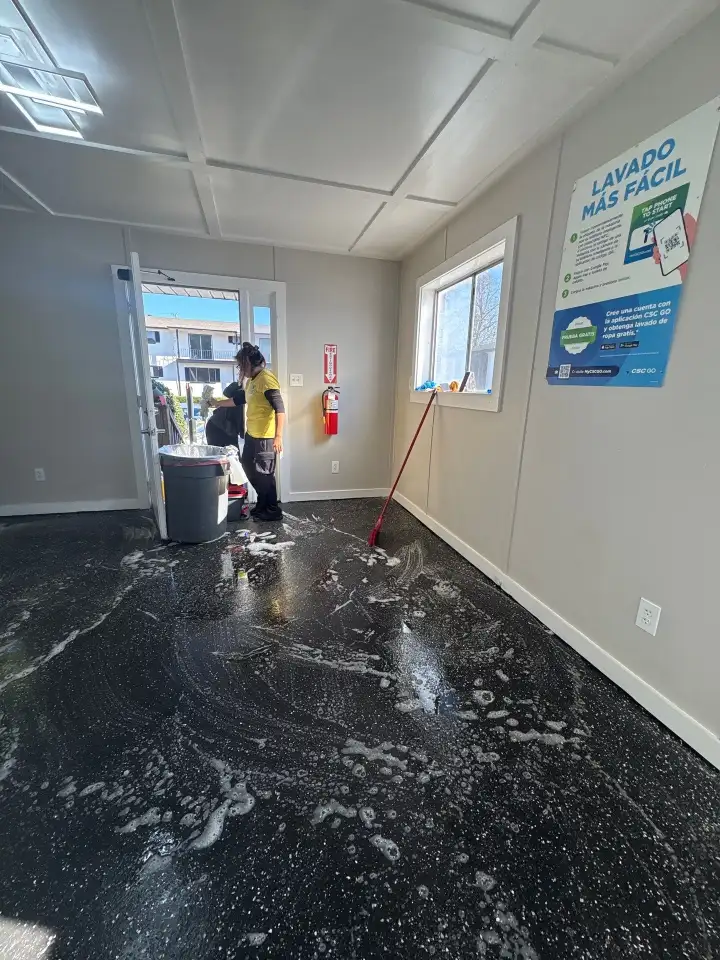
Buffing, scrub-and-recoat, and full strip-and-refinish are different work scopes. Buffing treats an intact compatible finish; a scrub-and-recoat adds finish when the existing layer is serviceable; full stripping removes a failed or unsuitable finish before rebuilding it. The selected method changes labor, materials, closure time and therefore the price.
For a detailed method-selection framework, read when to strip and wax versus buff commercial floors. For project planning, request separate line items for preparation, coating removal, new finish, furniture movement and cure time. If you need recurring cleaning instead of refinishing, see commercial floor cleaning services in Huntsville.
What Kind of Commercial Floors Can Be Stripped and Waxed?
Commercial floor stripping and waxing is most commonly associated with VCT, or vinyl composition tile.
VCT is designed around a structured maintenance program that can include regular cleaning, buffing or burnishing, recoating, and eventually stripping and replacing the protective finish.
Other resilient flooring materials may accept protective finishes, but the manufacturer’s maintenance instructions should determine the correct procedure.
Do not assume that every LVT, LVP, laminate, natural-stone, concrete, rubber, or wood floor needs traditional stripping and waxing.
Many modern products use factory-applied wear layers, specialized coatings, sealers, polishing systems, or manufacturer-specific maintenance procedures.
Armstrong Flooring, for example, notes that many LVT products require routine cleaning without the same required polish-maintenance system used for traditional VCT.
Identify the flooring material first. Paying for an unnecessary process wastes money, while applying an unsuitable stripper or finish can affect the floor’s appearance and future maintenance requirements.
What Should a Strip and Wax Quote Contain?
When comparing proposals from commercial floor-care companies, do not compare only the price per square foot.
Make sure each contractor is quoting approximately the same scope of work.
A useful commercial floor-care proposal should identify:
- Measured service area
- Floor type
- Stripping process
- Preparation requirements
- Number of finish coats
- Edge and detail work
- Furniture responsibilities
- Scheduling requirements
- Drying or curing requirements
- Equipment and final cleanup
You should also ask whether the quoted price assumes a standard stripping process or whether unusually heavy finish buildup will be treated as additional work.
This can prevent a low initial estimate from becoming a much larger final invoice.
If the floor work is part of a larger building-maintenance agreement, compare specialty floor work separately from routine commercial cleaning in Huntsville .
How Often Do Commercial Floors Need to Be Stripped and Waxed?
There is no universal annual stripping schedule. Floor-finish condition, traffic patterns, grit control, cleaning quality and the finish manufacturer’s instructions matter more than the calendar. An intact finish may respond to suitable buffing or scrub-and-recoat rather than a complete strip.
Use the strip-versus-buff comparison to evaluate condition before pricing a full reset. This page focuses on the cost of an approved strip-and-refinish project rather than prescribing when every building should schedule one.
How Can You Reduce Commercial Floor Stripping and Waxing Costs Without Cutting Corners?
The cheapest proposal is not necessarily the most economical long-term floor-care program.
Leaving out necessary finish coats, applying new finish over contamination, failing to prepare the floor correctly, or rushing drying time can shorten the life of the work and result in another restoration sooner than necessary.
A better way to control cost is to eliminate avoidable labor and maintain the floor properly between major restoration projects.
- Move furniture before the crew arrives. Less furniture handling means more crew time can be spent on the actual floor.
- Combine adjoining areas where practical. Larger continuous work areas are generally more efficient than several separate mobilizations.
- Maintain the finish between restoration projects. Regular cleaning, burnishing, and appropriate scrub-and-recoat work may delay a complete strip.
- Provide accurate square footage and floor information. Better information helps contractors prepare more useful preliminary pricing.
- Ask for a detailed scope. Make sure competing contractors are actually quoting comparable work.
If you are budgeting for the entire cleaning program rather than only the floor, our guide to commercial office cleaning cost per square foot covers the recurring-cleaning side of the budget separately.
When Stripping and Refinishing Is Not the Best Option
This is an important point that is often overlooked: not every dull commercial floor needs to be completely stripped.
Where the finish is still structurally sound, a scrub-and-recoat procedure may restore protection for less money and with less downtime.
If the only problem is reduced gloss or light scuffing, buffing or burnishing may be enough.
On the other hand, repeatedly recoating a dirty, yellowed, contaminated, or excessively built-up finish can simply hide the problem underneath another layer.
The correct recommendation should match the condition of the floor. It should not be based on automatically selling the most aggressive or expensive procedure available.
Frequently Asked Questions About Commercial Floor Stripping and Waxing Cost
How much does it cost per square foot to strip and wax a commercial floor?
A broad published 2026 national range is approximately $0.50 to $3.00 per square foot. HomeGuide lists VCT at approximately $0.50 to $1.50 per square foot, while an Alabama commercial floor-care benchmark is around $0.30 to $0.80 per square foot. Actual pricing depends on floor condition, size, layout, finish requirements, and access.
How much will it cost to strip and wax 5,000 square feet?
Using an illustrative Alabama planning range of $0.30 to $0.80 per square foot, 5,000 square feet works out to approximately $1,500 to $4,000. HomeGuide’s broader national 2026 example for 5,000 square feet is approximately $2,500 to $6,300, showing why local scope and floor condition matter.
Why can two strip-and-wax bids vary dramatically in price?
The contractors may not be bidding the same scope of work. Differences can include existing-finish condition, furniture moving, stripping passes, edge work, finish quality, number of coats, working hours, layout, minimum charges, and additional restoration requirements.
Is stripping and waxing the same as buffing?
No. Buffing or burnishing works with the existing finish to improve gloss and remove light surface wear. A full strip removes the existing finish so the protective floor-finish system can be rebuilt.
Does every commercial vinyl floor need stripping and waxing?
No. Traditional stripping and refinishing is most strongly associated with VCT. Other vinyl flooring products can have very different maintenance requirements. Check the flooring manufacturer’s recommendations before applying stripper or floor finish.
Is the most affordable strip-and-wax bid always the best choice?
No. A lower price can be legitimate if the contractor has an efficient crew or the floor is straightforward to restore, but compare the complete scope. Fewer finish coats, limited edge work, inadequate stripping, or excluded furniture handling can make two seemingly similar proposals very different.
Getting an Accurate Price for Your Commercial Floor
The first things to determine are the floor type, approximate serviceable square footage, current condition, finish buildup, major obstacles, and how quickly the facility needs to return to normal use.
Mid City Commercial Cleaning provides professional strip and wax floor services for commercial properties in Huntsville and surrounding North Alabama communities.
That service page explains the actual floor-restoration service and facilities served.
This article intentionally has a different purpose: helping building owners and facility managers understand what influences price before requesting a proposal.
For a building-specific figure, request a floor-care quote based on the condition and requirements of your actual floor rather than relying solely on an online per-square-foot average.
Sources and Pricing Methodology
This guide uses published September 2026 pricing and floor-maintenance information from the following sources:
- HomeGuide — “How Much Does It Cost to Strip and Wax Floors? (2026)”: national strip-and-wax pricing, VCT pricing, project-size examples, service minimums, and common cost factors.
- Homewyse — “Cost to Strip and Wax Floor — 2026 Cost Calculator”: September 2026 national starting estimates and stated project assumptions.
- CleanQuote — “Floor Care in Alabama”: Alabama commercial floor-care and strip-and-wax planning benchmarks.
- Armstrong Flooring Commercial: VCT maintenance guidance covering polish application, scrubbing, recoating, burnishing, and restorative stripping.
These published figures are used as budgeting references only. They are not presented as guaranteed Mid City Commercial Cleaning rates.