Compliance & Health
Difference Between Cleaning, Sanitizing, and Disinfecting
Cleaning removes dirt, organic matter, and many germs from a surface; sanitizing reduces bacteria on a surface to levels considered acceptable for public health; disinfecting uses an EPA-registered product to kill viruses and bacteria on surfaces according to the product label. In most situations, cleaning comes first because dirt and residue can interfere with sanitizers and disinfectants. Sanitizing is not the same as disinfecting: EPA describes surface sanitizers as products intended to kill bacteria, while disinfectants are tested and registered to kill viruses and bacteria. For many ordinary offices and community facilities, CDC says routine cleaning is often enough unless someone has been sick or conditions call for disinfection.
The three words are often used as if they mean the same thing, but they describe different outcomes. A desk can look clean without being sanitized. A sanitizer can reduce bacteria without carrying a virus claim. A disinfectant can be the correct chemical but still be used incorrectly if the surface is dirty or wiped dry before the required contact time.
The practical question is not which term sounds strongest. It is what the surface needs, what organisms matter, what rules apply to the facility, and what the product label requires.

Cleaning, Sanitizing, and Disinfecting at a Glance
| Process | Main goal | Effect on germs | Typical use |
|---|---|---|---|
| Cleaning | Remove dirt, residue, grease, dust, and organic matter. | Physically removes many germs rather than necessarily killing them. | Routine maintenance, visible soil, floors, desks, restrooms, high-touch surfaces. |
| Sanitizing | Reduce bacteria to an applicable safe level. | EPA surface sanitizers are intended to kill bacteria; they are not automatically virus claims. | Food-contact areas, certain shared objects, and situations where sanitizing is the required level. |
| Disinfecting | Kill viruses and bacteria named by the registered product. | Kills listed pathogens when label directions are followed. | Illness events, outbreak response, certain high-risk spaces, and healthcare protocols. |
The strongest-sounding process is not automatically the right one. Routine disinfection of every surface can add chemical exposure, labor, residue, surface wear, and cost without necessarily improving outcomes. Conversely, routine cleaning alone may be insufficient when a regulated setting or illness event requires a true disinfection step.
What Is Cleaning?
Cleaning is the physical removal of dirt, dust, organic material, residue, and many germs. EPA describes cleaning as removing dirt and organic matter from surfaces using soap or detergents. CDC likewise explains that cleaning with soap or detergent lowers the number of germs on surfaces and, in many everyday situations, can remove most harmful germs.
Cleaning is usually mechanical. Wiping, scrubbing, vacuuming, mopping, rinsing, and washing move contaminants away from the surface. A cleaner may contain chemicals, but the purpose of the cleaning step is removal rather than making a registered germ-kill claim.
A surface can be clean without being disinfected. If a desk has had dust, fingerprints, and crumbs removed, it may be clean even though no disinfectant was used.
What Is Sanitizing?
Sanitizing reduces germs on surfaces to levels considered acceptable under public-health codes or standards. EPA’s surface-product explanation is especially useful: sanitizers kill bacteria on surfaces but are not intended to kill viruses unless the product also has a separate registered disinfectant claim.
This distinction matters in kitchens and food-contact environments. Sanitizing is often a defined step after cleaning and rinsing. It should not be replaced with a generic “spray and wipe” routine. Restaurants can also have specific concentration, contact-time, rinse, and air-dry requirements. For that separate intent, see our guide to cleaning a restaurant kitchen to health code.
What Is Disinfecting?
Disinfecting uses an EPA-registered antimicrobial product to kill viruses and bacteria on surfaces according to the organisms and directions listed on the product label. EPA regulates surface disinfectants as antimicrobial pesticides, and the product must support its registered efficacy claims.
A disinfectant is not automatically effective against every pathogen. The label determines what the product is registered to kill, where it can be used, how it should be applied, and how long the surface must remain wet.
If the goal is to hire a contractor rather than understand the terminology, the site’s commercial sanitizing and disinfection services page owns that service intent.

Why Does Cleaning Usually Come Before Sanitizing or Disinfecting?
CDC recommends cleaning before sanitizing or disinfecting because dirt and other impurities can make it harder for antimicrobial chemicals to work. In healthcare guidance, CDC also notes that organic and inorganic material can interfere with disinfection.
Imagine a restroom counter with visible soap residue and soil. Applying disinfectant over that residue does not remove it. A better process is to remove the soil first and then apply a sanitizer or disinfectant if the second step is needed.
Some registered products combine cleaning and disinfecting claims. Even then, the label controls the procedure. Heavy soil may still require pre-cleaning, and the surface may still need to remain visibly wet for a defined contact time.
Cleaning vs. Sanitizing: What Is the Difference?
The simplest distinction is removal versus reduction. Cleaning physically removes soil and many germs. Sanitizing uses a validated process or registered product to reduce bacteria to the required level.
The processes often work together. A table may be cleaned to remove crumbs, grease, and residue, then sanitized if the setting requires a bacterial-reduction step. Sanitizing a visibly dirty surface without first removing soil is generally poor practice because the soil can interfere with the sanitizer.
Sanitizing vs. Disinfecting: Which Is Stronger?
EPA states that sanitizers and disinfectants are both antimicrobial pesticides, but surface disinfectants must meet more rigorous effectiveness requirements. Many products are registered for both sanitizing and disinfecting because they have been tested for both claims.
The useful difference is not simply “weak chemical” versus “strong chemical.” It is a difference in the registered claim, test standard, organisms targeted, and directions for use. A sanitizer used correctly can be exactly right for a sanitation task. A disinfectant is appropriate when disinfection is required.
Using a disinfectant also does not excuse poor technique. If the label requires a surface to remain wet for five minutes and it is wiped dry after thirty seconds, the procedure has not followed the label.
Which Process Does Your Facility Need?
Offices and General Workplaces
Routine cleaning is usually the baseline. CDC says high-touch surfaces should be cleaned regularly and other surfaces when visibly dirty. Disinfection can be added when someone has obviously been ill, during certain outbreaks, or where the facility’s risk profile calls for it.
Restaurants and Food Areas
Food-contact surfaces often have a defined clean-rinse-sanitize sequence. A general disinfectant routine is not a substitute for food-safety sanitation rules.
Healthcare Facilities
Healthcare settings may have infection-prevention procedures that go beyond general community guidance. The separate medical facility cleaning page for Huntsville owns the service-specific healthcare intent.
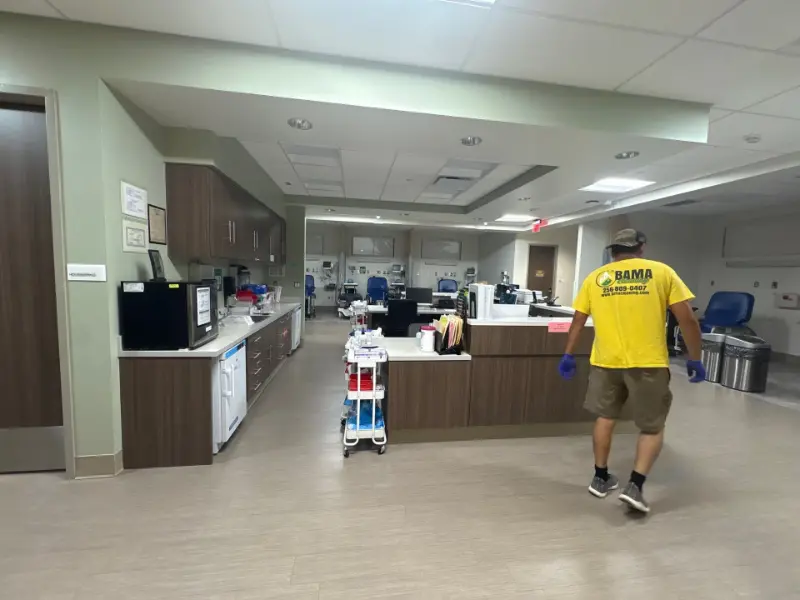
Schools, gyms, churches, retail spaces, industrial buildings, and public facilities can also have different needs. The right process depends on the environment, the surface, traffic, known illness, industry rules, and product label.
EPA Registration, Contact Time, and Product Labels Matter
When a sanitizer or disinfectant is used, the product label defines where it can be used, which organisms it is registered to address, how it should be diluted or applied, safety precautions, and the required contact time.
Contact time is the period the treated surface must remain wet for the antimicrobial claim. Spraying and immediately wiping a disinfectant dry may shorten that required exposure.
Chemical safety matters too. Employees should have access to the appropriate Safety Data Sheets and hazard information. For that narrower topic, see what an SDS binder is and why cleaners need access. Broader employer duties are covered separately in the site’s OSHA requirements for commercial cleaning guide.
Common Mistakes to Avoid
- Using the terms interchangeably. Cleaning, sanitizing, and disinfecting have different purposes.
- Applying disinfectant over visible dirt. Soil can interfere with performance.
- Assuming sanitizer kills viruses. A sanitizer-only claim is not automatically a virus claim.
- Ignoring contact time. The surface may need to stay visibly wet for a specific period.
- Assuming more chemical is always better. Overuse can increase residue, exposure, cost, and surface damage.
- Using an application method not allowed by the label. Fogging, spraying, or electrostatic application should match the registered directions.
Candid point: more disinfection is not automatically better cleaning. A good facility program uses the least aggressive process that reliably meets the hygiene requirement and reserves disinfection for situations where it adds value or is required.
Frequently Asked Questions
What is the main difference between cleaning, sanitizing, and disinfecting?
Cleaning removes dirt, organic matter, and many germs. Sanitizing reduces bacteria to an applicable safe level. Disinfecting uses a registered antimicrobial product to kill viruses and bacteria according to its label claims.
Do you sanitize or disinfect before cleaning?
Usually no. CDC recommends cleaning first because dirt and impurities can make sanitizers and disinfectants less effective.
Does sanitizing kill viruses?
Not necessarily. EPA says surface sanitizers are intended to kill bacteria and are not automatically virus claims unless the product also has a registered disinfectant claim.
Is disinfecting always necessary in an office?
No. CDC says routine cleaning is sufficient in many community settings. Disinfection is more appropriate when someone has been obviously ill, during certain outbreaks, or where facility-specific risks justify it.
Can one product clean and disinfect?
Yes, some EPA-registered products include both cleaning and disinfecting directions. The label still determines whether pre-cleaning is required and how long the surface must remain wet.
Is disinfecting the same as sterilizing?
No. Disinfection kills or inactivates many disease-causing microorganisms on inanimate surfaces. Sterilization is a higher-level process intended to destroy all forms of microbial life, including bacterial spores, under specified conditions.