Floors & Specialty Services · Slip Prevention
How Do You Prevent Slips and Falls During Commercial Floor Cleaning?
Prevent slips and falls during commercial floor cleaning by keeping people out of wet work zones, providing an accessible alternative route, using appropriate warnings and barriers, choosing floor-compatible products, and reopening the area only when conditions are safe. Wet-floor signs are useful but not sufficient by themselves. The plan must account for foot traffic, drying conditions, spills, and the specific floor surface. Employers also need to meet applicable workplace safety requirements; cleaning efficiency should not override pedestrian safety.
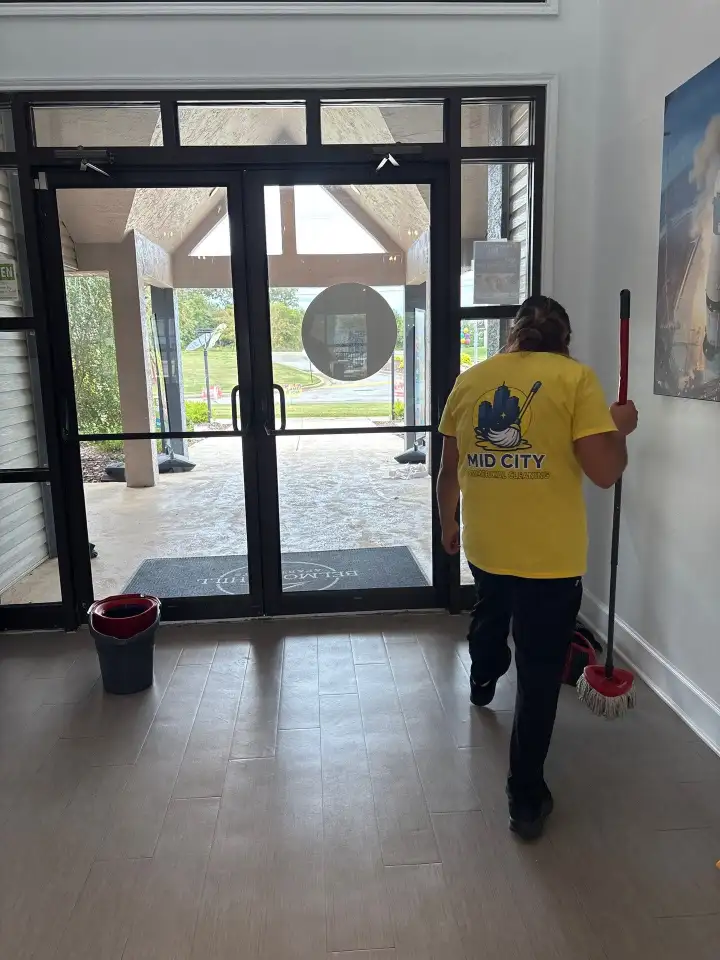
Why cleaning can temporarily make a floor more hazardous
A surface that needs cleaning may already have grease, tracked-in rainwater, dust, or spills. Adding cleaning solution can temporarily increase slipperiness, especially if the wrong chemical is used or residue remains. Mops, cords, hoses, carts, and cleaning machines can obstruct walking routes as well. A successful result is not simply a visually shiny floor; it is a properly cleaned surface that can be used safely.
An office hallway, busy restaurant entrance, or retail lobby cannot always be closed for the same amount of time. A facility manager should identify which routes are essential, which can be diverted, and which tasks need to happen before opening or after close. The goal is to avoid creating an unexpected hazard while trying to remove another one.
Floor-Cleaning Slip Controls: What Actually Changes Risk?
| Condition | Practical control | Common mistake |
|---|---|---|
| Wet walkway | Close, reroute or effectively isolate until safe | Relying only on a sign |
| Extension cord or machine hose | Route or protect away from pedestrian traffic | Leaving a trip hazard across a corridor |
| Incorrect floor product | Use manufacturer-suitable cleaning method | Applying a generic treatment to every surface |
| Recent spill | Respond promptly and protect the area | Allowing traffic across residue |
| Near miss or incident | Record, investigate, and correct the cause | Treating the sign itself as the solution |
Safety Standards and Controls Before Cleaning
What does OSHA require about floor conditions?
OSHA’s general walking-working surfaces standard, 29 CFR 1910.22, requires covered employers to maintain safe walking-working surfaces. It includes requirements to keep floors clean and, to the extent feasible, dry, and to address hazardous conditions before people use affected areas. A wet process may require appropriate drainage and dry standing areas where feasible. The standard does not establish a universal number of minutes that every mopped floor must dry.
Requirements depend on the workplace and conditions. A warning sign does not eliminate the duty to address an unsafe surface. If the area remains hazardous, access may need to be restricted until it is corrected or adequately guarded. Building managers and cleaning contractors should agree on who controls access during the job and who authorizes reopening.
Identify pedestrian routes before starting
Map entry doors, accessible routes, restrooms, stairways, elevators, reception, and emergency exits. Choose a cleaning sequence that preserves safe access. A short corridor with one entrance may need an off-hours cleaning window. A wide lobby may permit one side to be cleaned at a time if the other side remains suitable for use. Route plans should respect emergency egress and accessibility needs, not simply convenience for the cleaning team.
Tell staff in advance when a heavily used route will be affected. Where the building has visitors, use clear directions and visible barriers rather than expecting first-time guests to infer the intended detour. If a safe alternate path is not available, reschedule the job or use another suitable method instead of forcing people through the wet area.
Are wet-floor signs enough?
No. Signs communicate a hazard, but they do not physically prevent a visitor from stepping onto a slippery surface. Depending on the situation, cones, barriers, temporary closure, staff guidance, or cordoned work zones may be appropriate. Use signs that are visible from the approach routes and remove them when the hazard is gone; permanently displaying warnings can reduce their usefulness.
The details depend on the room layout and local safety plan. A small sign placed behind a wet patch is less useful than warning someone before they reach it. Where children, mobility-impaired visitors, or large crowds may be present, plan additional precautions based on the actual setting. The safer question is “can someone enter the hazard?” rather than “did we place a sign?”
Choose the right product and process for the surface
The wrong detergent concentration or finish can leave a slippery film. Different surfaces have different requirements: ceramic tile, resilient floors, polished concrete, wood, and stone should not all be treated with the same chemical or machine. Follow manufacturer guidance for both the flooring and the cleaning product, including rinsing when required. Replace dirty mop solution or pads rather than repeatedly spreading residue.
A separate guide to polished concrete floor care addresses one material in depth. For finish restoration, the site’s stripping, waxing, and buffing comparison explains why those methods are different. Routine mopping safety should not be confused with complex floor restoration or the drying and curing requirements for applied finishes.
Managing Occupants and Responding to Incidents
How long should the area remain closed?
Until it is safe for expected use—not for a universal predetermined interval. Drying depends on the amount of water, floor texture, product, temperature, humidity, ventilation, and whether a machine has recovered the solution. A “five-minute dry time” printed on a generic checklist is not reliable in every building. Follow product instructions and verify the condition before reopening the route.
An illustrative schedule might reserve a 20-minute window for a modest area that can be cleaned and checked quickly, but this is not a safety guarantee or a recommendation to open after 20 minutes. If the floor is still damp or slippery, keep the area restricted. The person responsible for the site should know who verifies completion, rather than relying on the disappearance of the cleaning cart.
What changes when employees and visitors are present?
If cleaning must take place during office hours, arrange access windows room by room, warn building occupants before work begins, and identify a safe alternative route. Our guide to scheduling cleaning around occupied workspaces covers the broader question of minimizing workplace disruption. Here the deciding issue is narrower: no foot traffic should be routed through a condition that remains slippery or otherwise hazardous.
Occupied spaces need stronger coordination. Employees may have set arrival times; deliveries may use an entrance at unpredictable intervals; and visitors may not know alternate routes. Spot-cleaning a small spill can often be handled promptly with a controlled work area. Wet cleaning an entire corridor may be better done after hours. Work also needs to account for workers carrying boxes, wheelchair users, and anyone who cannot easily take the suggested detour.
The purpose of a flexible plan is not to avoid cleaning during business hours entirely. It is to match the method and timing to the real use of the space. Review the building schedule, flag routes that cannot be closed, and create a clear escalation process if a spill occurs during peak traffic.
What should the cleaning company and manager agree on?
Write down which surfaces will be cleaned, approved products, times, barriers, temporary routes, drying or curing requirements, and the person who checks the area at handover. Also define who reports recurring leaks or deteriorated flooring. If a task requires a machine or specialist equipment, check where it will be staged and how cords and hoses are controlled.
A clear commercial cleaning scope of work should identify service boundaries and responsibilities. If the provider is expected to perform floor restoration, specify that separately from ordinary mopping. Do not make safety depend on an unwritten understanding between the night cleaner and whichever employee opens the next morning.
What should happen after a slip or near miss?
Attend to the person’s immediate needs and follow the site’s emergency and incident-reporting process. Preserve relevant facts: exact location, conditions, photographs if safe and appropriate, cleaning method, signs or barriers used, and timing. A near miss is valuable information even when no one is hurt. It may reveal a recurring entrance-water problem, poor route planning, or a floor product leaving residue.
Review the underlying cause rather than assuming the correct response is simply to add another sign. The floor itself may need maintenance; a mat may be unsuitable; the process may use too much solution; or the schedule may conflict with traffic. Corrective actions should be assigned to an owner and checked later for effectiveness.
Frequently Asked Questions
Are wet-floor signs enough to prevent falls?
No. Signs warn people, but access control, drying, safe product use and pedestrian routing may also be required.
When can a mopped area reopen?
When it is safe under the product, surface and site conditions—not automatically after a fixed number of minutes.
Who should decide whether a corridor can remain open?
The cleaning provider and facility manager should agree in advance on routes, barriers, authority and response to unexpected traffic.
The practical approach for Huntsville facilities
A safe floor-cleaning plan is visible in advance, compatible with the surface, and easy for staff and visitors to follow. Clean and dry conditions matter more than appearance alone. Businesses considering commercial floor cleaning in Huntsville should ask about traffic control, product compatibility, and reopening checks—not just equipment and price. You can contact Mid City about floor cleaning options and describe the exact routes, occupancy, and floor type that need attention.