Office Cleaning
Office Cleaning for Cummings Research Park Businesses: Security, Labs & After-Hours Access
In Cummings Research Park, the first question for an office-cleaning provider is not how many desks need dusting, but which spaces fall inside the janitorial scope. Research and technology tenants may have ordinary reception areas beside prototype, laboratory, electronics, or controlled-access rooms. Cleaning routes should mark those boundaries before work begins, separating public-facing floors, conference rooms, glass partitions, and breakrooms from spaces governed by tenant-specific procedures. Access permission, permitted supplies, and the method of verifying work must all be defined per building; a general Huntsville office checklist is not sufficient.
Why Research Park office cleaning is different
Cummings Research Park is not a single campus with one operating model. Its official tenant directory includes large defense and technology companies, small businesses, research organizations, higher-education institutions, healthcare-related companies, hotels, and support services. Cleaning requirements therefore vary widely even between neighboring buildings.
The cleaner’s first job is to understand the space map. Which rooms are normal office environments? Which are controlled? Which require a badge? Which are labs? Which contain sensitive equipment or records? Which are landlord-managed common areas? A clear map reduces security risk and prevents cleaners from making assumptions based only on an open door.
Build access rules into the cleaning scope
Document key, badge, fob, and alarm procedures before service begins. The plan should identify approved entrances, cleaning windows, escort requirements, restricted rooms, emergency contacts, and what to do when an area cannot be accessed. If the cleaner is not authorized for a room, that should be an explicit exclusion rather than an informal understanding.
For offices that handle sensitive work, define rules for desks, whiteboards, documents, screens, locked cabinets, shredding consoles, and conference-room materials. Cleaning teams should know which surfaces they may touch and which must be left alone. Security is part of the workflow, not an add-on conversation after a problem occurs.
Treat labs and technical spaces separately from normal offices
A janitorial company should not assume that a laboratory, clean space, electronics room, test area, machine area, or server room can be cleaned with the same chemicals, tools, or sequence used in a breakroom. Facility-specific SOPs should govern those spaces. In some buildings, the janitorial crew may clean only adjacent corridors and administrative offices while trained internal staff handle the technical area.
The scope should also identify equipment that cleaners must not move, unplug, wipe, or spray near. This protects both the facility and the cleaning crew. “Do not enter” and “do not touch” instructions are as important as the tasks that are included.
Choose an after-hours schedule that matches the workforce
Research Park businesses may operate traditional office hours, compressed schedules, multiple shifts, or extended project hours. A cleaning window that works for one tenant can interfere with another. Ask department leaders when conference rooms empty, when secure teams leave, and whether late-working employees need the crew to clean around them.
If the building has daytime public traffic, a hybrid model can work: a day porter handles restrooms, entries, spills, and common areas while the full office clean occurs at night. The site’s nightly cleaning versus day porter guide explains that general tradeoff.
Plan for floors, glass, and high-use collaboration areas
Technology and research offices often contain a mix of carpet, LVT, tile, polished concrete, glass conference rooms, collaborative spaces, cafeterias, and high-traffic entries. Each surface has a different maintenance cycle. Routine vacuuming and mopping should be separated from periodic carpet extraction, machine scrubbing, glass detailing, and floor restoration.
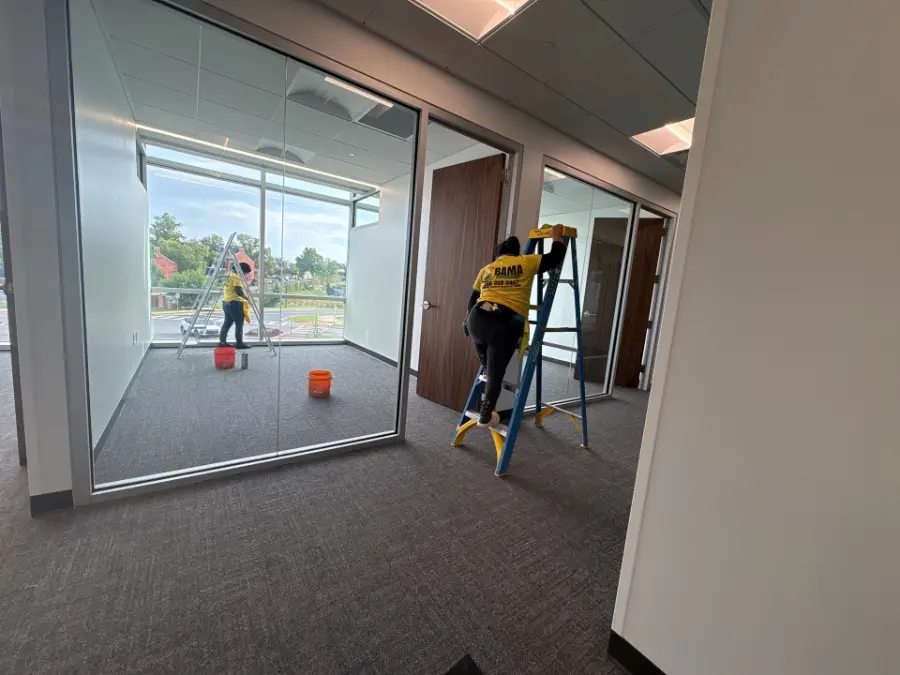
Glass-walled meeting rooms need special attention because fingerprints and smudges remain highly visible even when the rest of the office is clean. Entrances also carry soil from parking areas and sidewalks, so matting and entry-zone cleaning should be weighted more heavily than low-use interior corridors.
Use quality control that works in restricted buildings
A supervisor cannot always inspect every room if access is restricted. The account plan should define how quality is verified in secure zones, who can accompany an inspector if needed, and how the client reports misses without revealing sensitive information. The cleaner should be able to demonstrate consistency without forcing the facility to compromise access rules.
For general office standards, Mid City’s office cleaning in Huntsville page owns the transactional service intent, while the office high-touch checklist provides a task-focused reference.
Local context: Cummings Research Park
Cummings Research Park stretches across a substantial campus of offices, research buildings, and mixed tenant facilities rather than operating like one managed office tower. A visitor-facing lobby may need frequent glass and floor attention, while a nearby engineering suite may require a strict no-entry boundary around prototype benches or equipment rooms. Those are different cleaning assignments even when the two tenants share a parking area or landlord.
Use the Park’s tenant-by-tenant mix to guide the site survey: confirm which corridors and restrooms are landlord-managed; whether shared conference areas are booked late; whether electronics work limits moisture, sprays, or dust-raising methods; and whether verification can be done without photographs in controlled areas. Do not assume working in the Park grants cleaners access to Redstone Arsenal or any individual secure tenant facility.
Authoritative references
Set up the Research Park account before the first cleaning shift
For a Research Park tenant, the first cleaning shift should not be the first time the crew learns the building. Conduct an orientation with the account manager and, when appropriate, the cleaners assigned to the site. Review approved entrances, badge rules, restricted rooms, emergency exits, alarm procedures, storage locations, chemical restrictions, waste streams, and the names of client contacts who can authorize changes. Mark ordinary office zones separately from technical or sensitive areas so the route is easy to follow even when a substitute cleaner is assigned.
It is also useful to define what evidence of service is appropriate. A standard office might use a digital checklist or supervisor inspection. A more sensitive workplace may prohibit photography or mobile devices in certain zones. Agree on a quality-control method that verifies completion without violating the tenant’s security rules. The best account setup is not the one with the most paperwork; it is the one that makes expectations clear enough that a trained backup can follow the same process without improvising.
Frequently asked questions
Do cleaners need special clearance to clean every Research Park office?
No single rule applies to every tenant. Access is controlled by the individual company or building. Some cleaners may work only in unrestricted office/common areas, while secure or technical spaces can require separate authorization or remain excluded.
Can a regular janitorial crew clean a laboratory?
Not automatically. Labs and technical rooms should follow facility-specific SOPs, chemical restrictions, equipment rules, and training requirements. Many janitorial scopes exclude technical areas unless they are specifically approved.
Is after-hours cleaning better for Research Park businesses?
Often, but not always. It reduces disruption in many offices, while facilities with late shifts or secure schedules may need a hybrid or carefully timed program.
What should be written into the scope?
Room classifications, access rules, restricted areas, routine office tasks, restroom and breakroom work, floors, glass, waste, periodic services, security procedures, inspection methods, and exclusions should all be documented.
Reviewed for publication using Mid City Commercial Cleaning’s current article design system, local SEO intent mapping, and publishing QA requirements.